CLOUD SERVICES

Cloud computing relies on shared IT resources rather than having local servers or personal devices to handle applications.
In its most simple description, cloud computing is taking services ("cloud services") and moving them outside an organization's firewall. Applications, storage and other services are accessed via the Web.
The services are delivered and used over the Internet and are paid for by the cloud customer on an as-needed or pay-per-use business model.
On-Premises
Generally speaking, on-premises solutions are physically located at an organization’s office site or in a hosting location of their choice. The application in use and all the data associated with it is stored on a server or a private cloud in this location. This enables the organization choosing to deploy in this way to fully control their own security and access to the data and application.
This also means, however, that the company is responsible for maintaining the hardware the application is being delivered from and maintaining security and access to that server location.
Cloud SaaS
Cloud or SaaS (Software as a Service) solutions are hosted and delivered via an off-site cloud system, typically accessed via a desktop or mobile browser. All data and configuration is held in the cloud and does not reside on the client site. Updates to the application, along with all security and availability, are usually the responsibility of the vendor who is delivering the service with no upkeep of physical servers to be considered.
Cloud solutions are usually also subscription-based and involve a monthly or annual fee for use, offering 99% plus uptime guarantees and the ability to load balance in region for optimal speed and performance delivery.
Hybrid cloud
A hybrid cloud solution is one where an organization uses a mix of on-premises private cloud and public cloud services. It can offer flexibility as it allows workloads to shift between the two when capacity and costs change. Sensitive workloads and data can be hosted in the private cloud, with less critical workloads hosted in a public cloud.
If a company has regulatory requirements for data handling and storage, then this can be provided in the private cloud. Or perhaps an organization could host its e-commerce site within a private cloud and their corporate site within the public cloud. Public cloud services such as Microsoft Azure or Amazon Web Services provide scalability, giving an organization the ability to pay only for the resources it consumes.
FROM NETWAVE USA WE CURRENTLY RECOMMEND THE FOLLOWING SOLUTIONS
AMAZON WEB SERVICES (AWS)
Provides on-demand cloud computing platforms and APIs on a metered pay-as-you-go basis. These cloud computing web services provide a set of primitive abstract technical infrastructure and distributed computing building blocks and tools.
Amazon Elastic Cloud provides a virtual cluster of computers through the Internet. AWS's version of virtual computers emulate most of the attributes of a real computer, including hardware central processing units (CPUs) and graphics processing units (GPUs) for processing; local/RAM memory; hard-disk/SSD storage; a choice of operating systems; networking; and pre-loaded applications softwares.
CITRIX CLOUD
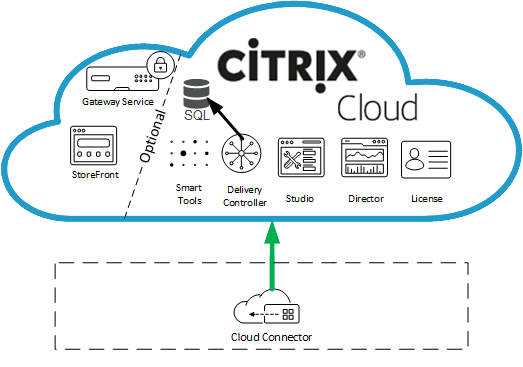
Is a platform that hosts and administers Citrix services. It connects to your resources through connectors on any cloud or infrastructure you choose (on-premises, public cloud, private cloud, or hybrid cloud).
It allows you to create, manage, and deploy workspaces with apps and data to your end-users from a single console.
VMWARE CLOUD ON AWS
VMware Cloud on AWS is an integrated cloud offering jointly developed by Amazon Web Services (AWS) and VMware.
You can deliver a highly scalable and secure service by migrating and extending your on-premises VMware vSphere-based environments to the AWS Cloud running on Amazon Elastic Compute Cloud (Amazon EC2).